
By Shaikh Ahmad Kutty
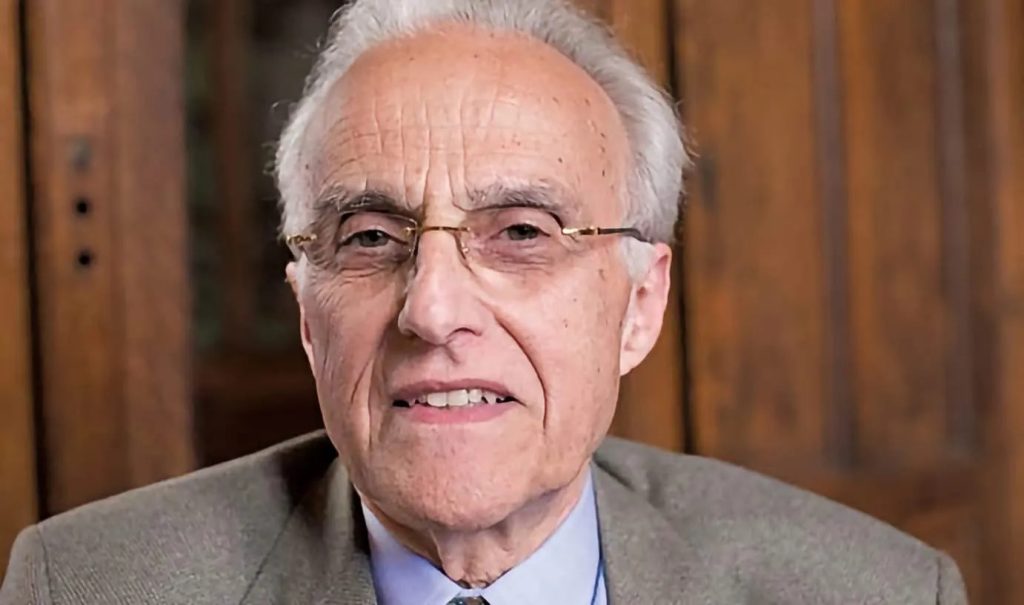
Professor John L. Esposito leaves behind a remarkable legacy in the study of Islam and Muslim–Western relations. His passing is a loss not only to the academic world but also to all who value truth, dialogue, and mutual understanding. Few scholars did more to explain Islam to Western audiences with fairness, balance, and intellectual integrity. At a time of growing misunderstanding, he became a trusted voice, helping people navigate tough conversations about religion, politics, and coexistence.
When public debate about Islam became clouded by fear or sensational headlines, journalists, educators, and community leaders often turned to Esposito. He responded not with rhetoric, but with evidence; not with suspicion, but with context. He believed that careful listening and informed understanding are always more powerful than prejudice and confrontation.
Esposito at Georgetown University
For many years, Professor Esposito served as Distinguished University Professor at Georgetown University, where he taught Religion, International Affairs, and Islamic Studies. He explored Islam not simply as a religion, but as a living faith that shapes the lives, cultures, and aspirations of diverse Muslim communities.
He founded the Prince Alwaleed bin Talal Centre for Muslim–Christian Understanding, creating a space where people of different faiths could meet in mutual respect and honest dialogue. Later, he helped establish the Bridge Initiative, a research project dedicated to studying Islamophobia and its impact on public life. These institutions reflected his lifelong conviction that Islam deserves to be studied with fairness, intellectual rigour, and ethical responsibility. When many spoke of a “clash of civilizations,” Esposito consistently called for dialogue, shared values, and cooperation in the pursuit of justice and peace.
Learning from Dr. Ismaʿil Raji al-Faruqi
Esposito did not begin his career intending to specialize in Islamic studies. Raised in an Italian-American Catholic family, he initially prepared for the priesthood before pursuing doctoral studies at Temple University.
There he came under the mentorship of Dr. Ismaʿil Raji al-Faruqi (1921–1986), one of the foremost Muslim thinkers of the twentieth century. Esposito often described this relationship as the turning point of his academic life. Under al-Faruqi’s guidance, he learned to approach Islam on its own terms rather than through inherited Western assumptions. Throughout his career, he remained committed to that principle, challenging misconceptions and encouraging genuine dialogue built on listening, learning, and mutual respect.
Bringing Islam to a Wider Audience
For countless readers, their first serious introduction to Islam came through Esposito’s books, including Islam: The Straight Path, What Everyone Needs to Know About Islam, The Islamic Threat: Myth or Reality?, Unholy War, and The Future of Islam.
Written in clear, accessible language, these works became standard texts in universities while also reaching ordinary readers seeking a balanced understanding of Islam. Esposito explained Islamic history and contemporary Muslim life with nuance and context. He showed that Islam is not a monolithic tradition but a rich and diverse civilization shaped by different cultures, histories, and interpretations.
He rejected both idealized and hostile portrayals of Islam. Without ignoring the challenges facing Muslim societies, he resisted simplistic claims that reduced Islam to violence or extremism. Instead, he encouraged readers to appreciate the diversity of debates within the Muslim world on issues such as law, democracy, gender, and social change. For many Muslims, his work offered a fair representation of their faith; for many non-Muslims, it provided a welcome alternative to stereotypes and sensationalism.
A Courageous Voice Against Islamophobia
Following the attacks of September 11, 2001, fear and suspicion toward Muslims spread rapidly. Esposito became one of the clearest voices warning against blaming an entire faith for the crimes of a violent minority.
He repeatedly emphasized that Muslim movements are diverse and cannot be reduced to a single political or religious agenda. Through the Bridge Initiative, he documented how Islamophobia shapes media coverage, public policy, and everyday life, while providing educators, policymakers, and communities with tools to challenge prejudice.
Islam and Democracy
Esposito also made important contributions to debates about Islam and democracy. He argued that simplistic claims—whether for or against compatibility—ignore the diversity and complexity of Muslim thought.
In collaboration with John O. Voll, he showed how concepts such as shūrā (consultation), ijmāʿ (consensus), and ijtihād (independent reasoning) have inspired many Muslim thinkers to support accountable leadership and public participation. Drawing on examples from across the Muslim world, he emphasized that political outcomes are shaped not by religion alone but also by history, institutions, and human choice.
A Scholar Who Engaged Communities
Esposito was equally at home in lecture halls and community gatherings. He appeared frequently on international media, advised governments and public institutions, and consistently urged leaders to move beyond stereotypes toward informed engagement.
His influence reached far beyond North America. During his visit to Kerala, India, in January 2012, he took part in the First International Islamic Academic Conference at Al Jamia Al Islamia, Santhapuram, and addressed programmes organized by Jamaat-e-Islami Kerala. Those who heard him remember not only his balanced scholarship but also his humility, warmth, and unwavering commitment to dialogue.
I also had the privilege of meeting Professor Esposito at conferences organized by the Islamic Society of North America (ISNA) and the Muslim Students Association (MSA). He was not only a distinguished scholar but also a gracious mentor—approachable, patient, and generous with his time. He listened attentively, responded thoughtfully, and treated every question with genuine respect. His humility and warmth left a lasting impression on everyone who met him.
I also benefited immensely from his scholarship. Throughout my work as an imam, teacher, researcher, and writer, I frequently turned to many of his books, including his edited works such as the Encyclopedia of the Modern Islamic World and Muslims and the West, as well as several of his other publications. Time and again, I found them to be balanced, carefully researched, and dependable resources. They deepened my own understanding of Islam and contemporary Muslim societies and greatly assisted me in presenting Islamic teachings with clarity, fairness, and confidence.
My experience was shared by countless others. For more than four decades, Professor Esposito’s writings have been essential reading for scholars, students, educators, journalists, policymakers, and religious leaders around the world. His scholarship was distinguished by intellectual rigor, fairness, and a sincere desire to understand rather than judge. His books did more than inform; they shaped minds, encouraged thoughtful reflection, and inspired a more balanced and compassionate understanding of Islam and Muslims.
Honouring His Legacy
One commentator observed that, just as Edward Said challenged the assumptions of Orientalism, Professor John L. Esposito devoted his life’s work to correcting distorted perceptions of Islam and Muslims. Through careful scholarship and intellectual integrity, he replaced caricature with understanding, suspicion with knowledge, and fear with dialogue.
Like every influential scholar, Esposito’s work attracted criticism. Some questioned aspects of his analysis. Yet even many who disagreed with him respected his intellectual honesty, his deep engagement with Muslim sources, and his willingness to listen before reaching conclusions.
His legacy endures through his books, the institutions he helped establish, and the countless students, scholars, educators, journalists, policymakers, and community leaders he inspired. Across universities, research centres, and communities around the world, his influence continues to foster informed scholarship, constructive dialogue, and a deeper understanding of Islam and Muslims.
For Muslims and non-Muslims alike, Professor Esposito leaves enduring lessons. He showed that genuine scholarship begins with listening, that understanding requires humility, and that justice demands resisting prejudice and stereotypes. In this, he embodied a conviction often expressed by his mentor, Dr. Ismaʿil Raji al-Faruqi (1921–1986): seeking to understand the “other” with honesty and empathy does not weaken one’s own convictions—it is among the truest expressions of faithfulness to them.
As we remember Professor John L. Esposito with gratitude and respect, we pray that God, the Most Merciful and the Perfectly Just, rewards the good he brought to the world, forgives his shortcomings, and allows the fruits of his life’s work to continue building bridges of understanding for generations to come.